
AI Generated Ads Have No Taste. Here Is How to Give It Some
The model makes. It does not choose. Everything generic you shipped this year came out of that gap.

Henry SedgwickProduct marketing
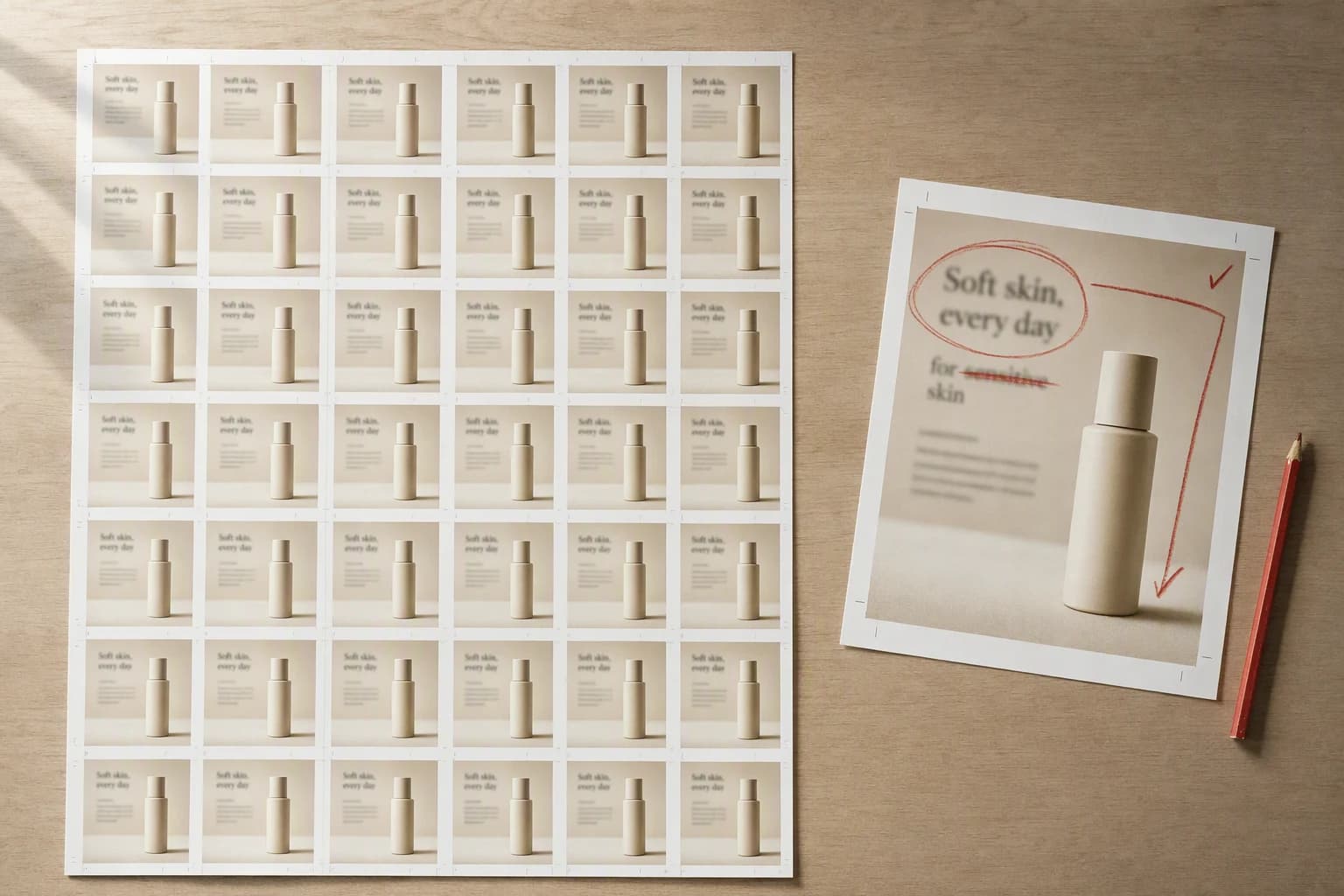
AI generated ads have no taste because taste is not a rendering problem. A model can now draw your bottle perfectly, hold the label steady across fifty frames and light it better than most studios, and still have no opinion about whether the headline should be a warning, a joke or a price. It makes. It does not choose.
So the fix is not a longer prompt. Another thirty words will not hand a model judgement it does not have. The fix is to stop asking it to choose, and to give it choices a person already made. That sounds like a dodge. It is closer to how good advertising has always worked, and below I take a real ad apart to show what those choices look like written down.
01
Why AI generated ads have no taste
The clearest evidence is not in my ad account, it is on television. Two of the largest advertisers in the world put real money behind AI holiday campaigns and both landed badly. Neither failed on rendering.
4 days
How long the McDonald’s Netherlands AI Christmas ad lasted. Out on 6 December 2025, pulled on the 10th.
2 years
Coca-Cola ran an AI holiday ad in 2024 and again in 2025, and met the same reception both times.
10x
Coke’s own head of generative AI said the craftsmanship was ten times better the second year. It still read as slop.
The Nielsen Norman Group wrote up those campaigns and landed on something I keep seeing in much smaller accounts: audiences can tell when a story has been shaped around what the technology can do rather than what the ad needed to say. McDonald’s Netherlands did not have a rendering problem. It ran a Christmas ad telling people Christmas is miserable, then withdrew it four days later. That was a decision, and no model made it. No model would have caught it either.
02
Taste is not a vibe. It is a stack of decisions
This is the part everybody gestures at and nobody writes down. So here is a real ad I pulled out of the AIMS library, from Terrai Beauty, for a serum called One and Done. Read it as a list of decisions rather than as a picture, because that is what it is.
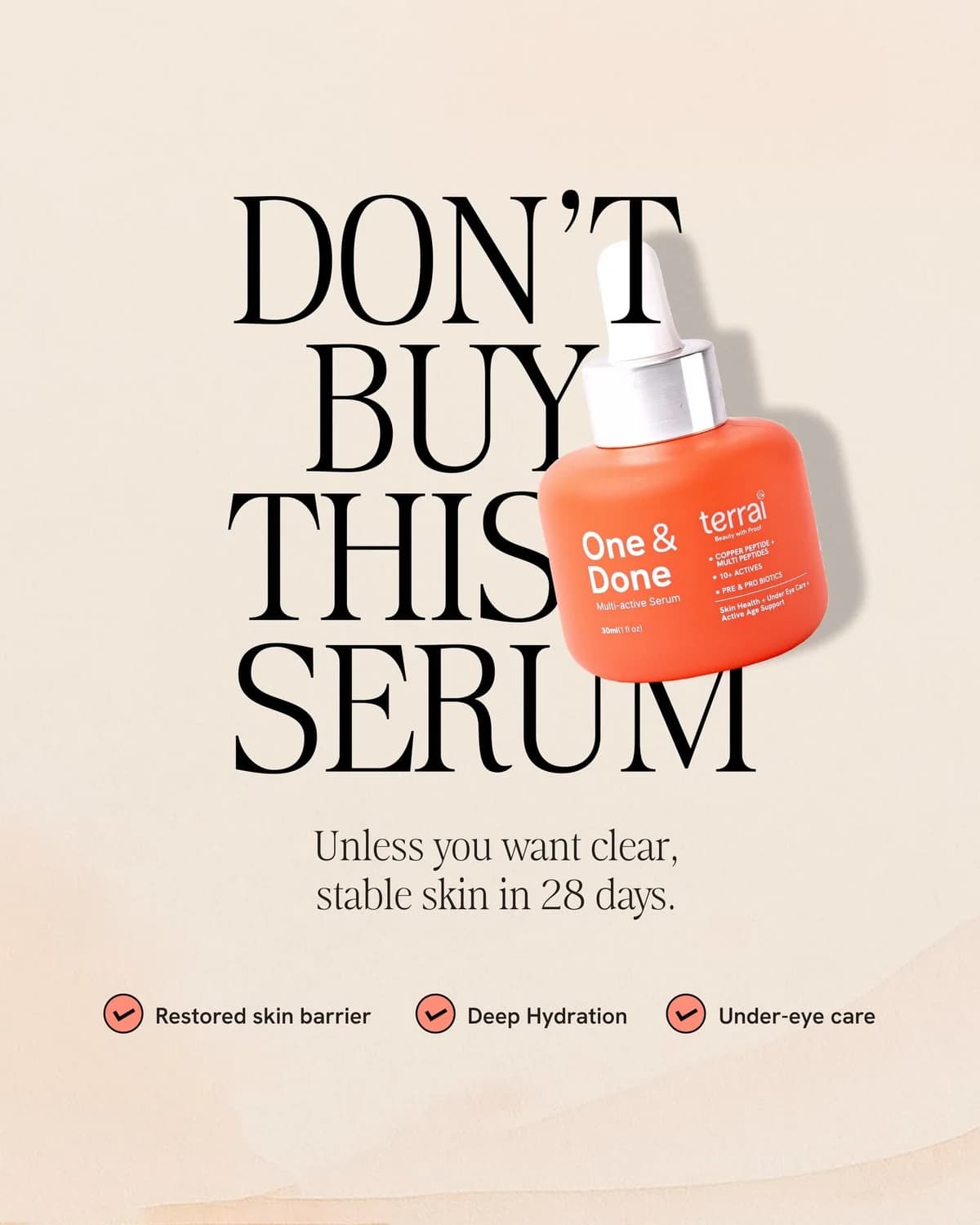
Six decisions, and the default each one refused
What Terrai chose
What a model gives you by default
“I wrote those six lines on a sticky note and rebuilt them for dog food. Don’t buy this food, unless your dog is bored of chicken. Four months on it is still our best static and I have not touched it.” Tom, pet food, about £1.2m a year
03
What the model hands you instead
For contrast, here is what came back when I asked an image model for a skincare serum ad and gave it nothing else. No reference, no decisions, which is exactly how most of these get made. This one is generated on purpose and it is meant to be bad.

Nothing in it is wrong. The bottle is rendered cleanly, the light is even, the type is legible. It is a perfectly executed nothing, and that is the problem. It cost me about two cents, which means everyone selling what you sell can make forty of them before lunch.
Rendering is solved
Products hold, light behaves, hands mostly have five fingers. The craft complaint from two years ago has largely been answered.
Deciding is not
The model has no view on whether the headline should insult the reader. It has no stake in the outcome, so it defaults to the safe middle.
And it is now free
Cheap generation lifts the floor for everybody at once. Sitting on that floor is the default outcome unless something in your process is making real choices.
04
Impact, communication and persuasion
There is an older framing for this and it is still the best one I know. Dave Trott drew a triangle on a flipchart and said every ad needs three things: impact, communication, persuasion. Get noticed, tell me what, tell me why. I found this version of it in the AIMS library, in a post by Harry Dry, and it is the sharpest picture of the AI creative problem I have seen despite having nothing to do with AI.
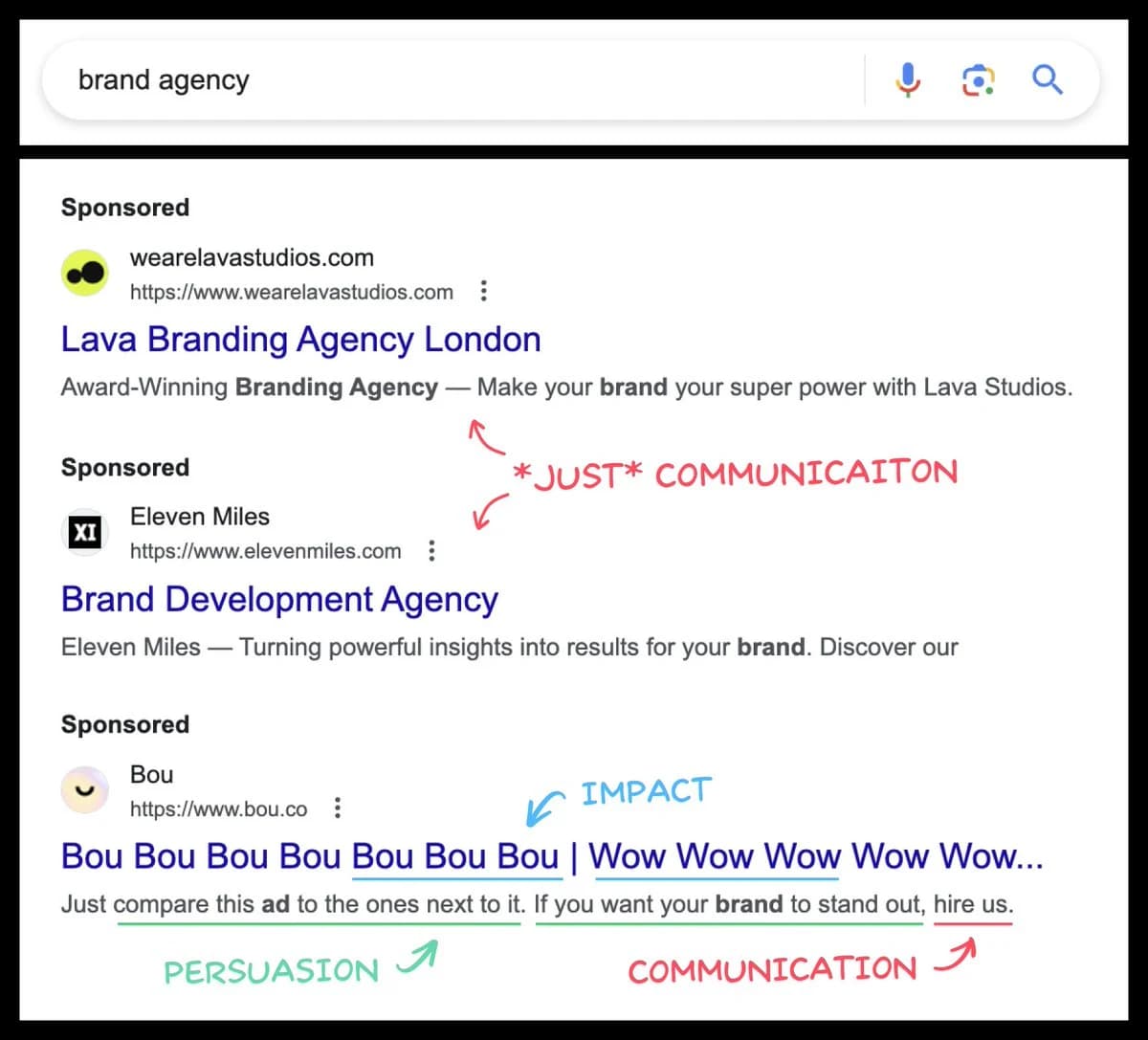
Communication is solved
Say what the product is and what it does. Models are genuinely excellent at this, and it is nearly all a prompt asks for.
Impact is unlikely by construction
Getting noticed means doing what nobody expects. A system trained on what usually happens will reliably produce what usually happens.
Persuasion needs a reason
Why you and not them is a fact about your business. It is not in the training data and it will not be in a fifteen word brief.
Most AI ads nail the communication corner and leave the other two empty. That is all anybody means when they say it has no taste.
05
How to give an AI generated ad some taste
- 1
Take the decisions, not the artwork
Find an ad you wish you had made and write down what it decided. Headline strategy, where the product sits, what got cut. If you cannot reach five lines you saved a pretty picture rather than an argument.
- 2
Shop outside your category
Every serum ad copies serum ads, which is why they all converge. The Terrai layout would carry a supplement, a hot sauce or a shampoo, and nobody in your feed would recognise where it came from.
- 3
Give the model the decisions and your product, in that order
The reference carries structure, crop, hierarchy and mood. Your own photography carries the thing you actually sell. A prompt on its own carries neither of those.
- 4
Keep the refusals
What makes a good ad good is usually the thing it removed. When you rebuild it, resist putting the badge, the second offer and the third line of copy back in.
- 5
Judge it against the reference, not your last ad
The question is not whether you like it. It is whether a stranger could pick which of the two had a person deciding.
06
Where borrowing taste stops working
I would rather you heard the limits from me than found them on a Tuesday with a launch booked.
- Net new concepts. Distilling a great ad gets you a great execution. It will not invent the idea that makes your category look at you differently, and I have not seen anything on the market that does.
- Offer led wins. If an ad worked because the offer was strong, copying the layout copies the wrong half. Work out what was doing the work before you rebuild it.
- Anything resting on a real person. A founder on camera, a customer holding the thing. A reference cannot lend you credibility you have not earned.
- Brand defining campaigns. The piece that sets how you look for the next three years deserves a person and a budget. This is for the forty ads you need next month.
07
Where AIMS fits
AIMS is a free searchable library of real ads, emails, videos and pins, indexed across Meta, Instagram, TikTok, Pinterest, Amazon and Etsy, which is where both the Terrai ad and the Harry Dry post above came from. Discover is the browsing half and the free Chrome extension saves anything you run into while you are out on the internet. The part that matters for this article is what happens after you save something: AIMS does the decision writing step itself, reads what the designer actually did, and passes that analysis to the model alongside your product photography and your palette. The teardown page walks through the loop. What comes back is your product, in that structure, with none of their assets in it.
“There are two of us and we ship about thirty statics a month. None of them start from a prompt any more. They all start from something we saved.” Nadia, kitchenware, team of two
08
FAQs
Why do AI generated ads look so generic?
Because a model is built to produce the likely answer, and taste is mostly the deliberate refusal of the likely answer. Ask for a serum ad and you get a bottle in the middle of a gradient, because that is where the middle of everything it has seen sits. It is not malfunctioning. Art direction was never what it was optimising for.
Can you prompt your way to good taste?
Not reliably. A prompt is a description, and what makes an ad work is structural: where the eye lands first, what got left out, how large the headline is against the product. You can try to describe that in five hundred words, or hand over one picture that already contains it.
Is using a competitor ad as a reference legal?
I am not a lawyer, so treat this as practice rather than advice. Taking layout, hierarchy and structural ideas is ordinary competitive behaviour and always has been. Reproducing their photography, their copy, their logo or their distinctive brand look is a different thing. Keep the method and replace every asset.
Does AI creative actually underperform?
The research points at perception rather than at the method. AI made ads hold up fine until viewers can tell they were AI made, and once the tells are visible the advantage goes. So the goal is not to hide it. The goal is to make something with enough intent behind it that nobody thinks to ask.
How many references do I actually need?
Fewer than you think. Ten ads you can explain beat four hundred you saved and never opened again. Supply was never the bottleneck.